
The Development History of Rubber V-Belts
1. Introduction
Rubber V-belts are one of the most widely used mechanical power transmission components in industrial and automotive applications. Since their invention, V-belts have played a crucial role in improving transmission efficiency, reliability, and operational flexibility. Their development reflects the progress of materials science, manufacturing technology, and industrial automation over more than a century.
2. Early Origins of Belt Drives
Before the introduction of V-belts, power transmission mainly relied on flat belts made of leather, cotton, or woven fabrics. These flat belts were simple in structure but suffered from frequent slippage, limited power capacity, and poor durability, especially under high loads and variable speeds.
In the late 19th and early 20th centuries, the rapid growth of industrial machinery created an urgent demand for more compact, efficient, and reliable transmission solutions. This need directly led to the development of the V-belt.
3. Invention of the V-Belt
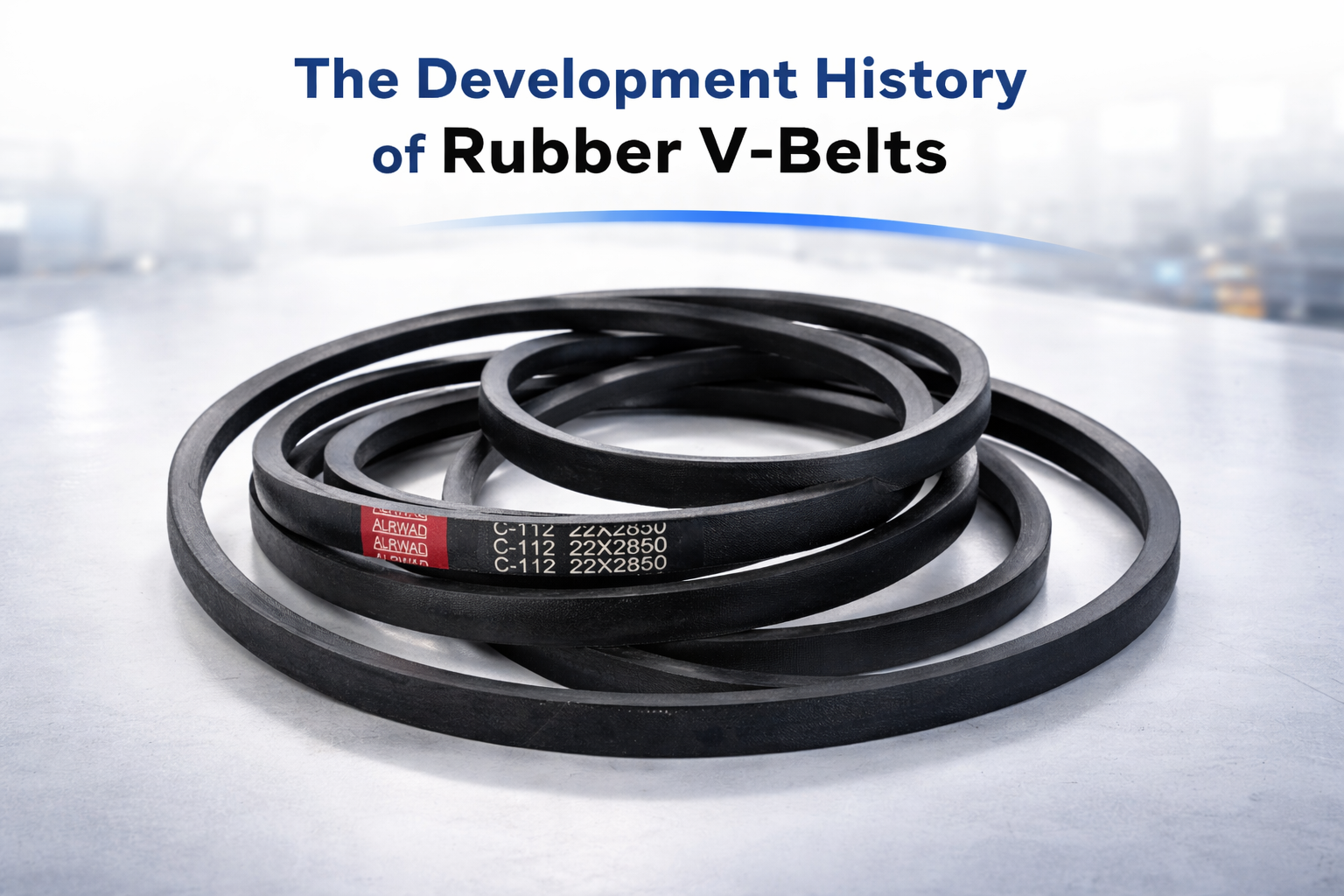
The modern rubber V-belt was officially introduced in 1917 by Gates Rubber Company. The key innovation was the trapezoidal (V-shaped) cross-section, which allowed the belt to wedge tightly into the pulley groove. This wedging effect significantly increased frictional grip and reduced slippage compared to flat belts.
Early V-belts were made of natural rubber reinforced with cotton cords. Although simple by today’s standards, these belts provided superior power transmission efficiency, smaller pulley sizes, and more compact drive systems.
4. Material and Structural Advancements
With the advancement of materials technology, rubber V-belts underwent continuous improvements:
Rubber Compounds: Natural rubber was gradually enhanced or replaced by synthetic rubbers such as CR (chloroprene rubber) and later EPDM, offering better heat resistance, oil resistance, and aging performance.
Tension Members: Cotton cords were replaced by rayon, polyester, fiberglass, and aramid fibers, significantly improving tensile strength, dimensional stability, and service life.
Fabric Covers: The introduction of impregnated fabric covers improved abrasion resistance and protected the belt core from environmental damage.
These innovations enabled V-belts to operate under higher speeds, heavier loads, and harsher working conditions.
5. Diversification of V-Belt Types
From the mid-20th century onward, various specialized V-belt types were developed to meet different application requirements:
Wrapped V-Belts for general industrial use
Raw Edge Cogged V-Belts with improved flexibility and heat dissipation
Narrow V-Belts for high-power, compact drives
Agricultural V-Belts designed for shock loads and dusty environments
Automotive V-Belts and later V-Ribbed (Poly-V) Belts for engines and auxiliary systems
This diversification greatly expanded the application range of rubber V-belts across industries.
6. Modern Manufacturing and Quality Standards
In modern production, rubber V-belts are manufactured using advanced processes such as precision mixing, controlled cord placement, automated building, and high-temperature vulcanization. Computer-aided design (CAD) and strict quality control systems ensure consistent performance and compliance with international standards such as ISO, DIN, RMA, and JIS.
Additionally, environmental considerations have driven the development of low-noise, energy-efficient, and long-life V-belts that contribute to reduced maintenance costs and lower carbon emissions.
7. Future Trends and Outlook
Today, rubber V-belts continue to evolve alongside smart manufacturing and sustainable development trends. Future innovations focus on:
High-performance materials with longer service life
Improved energy efficiency and reduced power loss
Maintenance-free or low-maintenance designs
Enhanced resistance to extreme temperatures and chemicals
Despite competition from chain and direct-drive systems, rubber V-belts remain irreplaceable in many applications due to their cost-effectiveness, flexibility, and reliability.